
With its spectacular waterfall and lush vegetation of over 200 plant species, the Jardin Extraordinaire recreates the spirit of Jules Verne’s Voyages extraordinaires, whilst being built on a former granite quarry.
Le Voyage à Nantes invited artist Barbara Schroeder, whose earth-based practice reveals hidden relationships between soil, plants, and the people who cultivate them.
For several years, Schroeder has used cow dung as her primary medium within an ongoing project she calls the “Mistérian Cycle.”
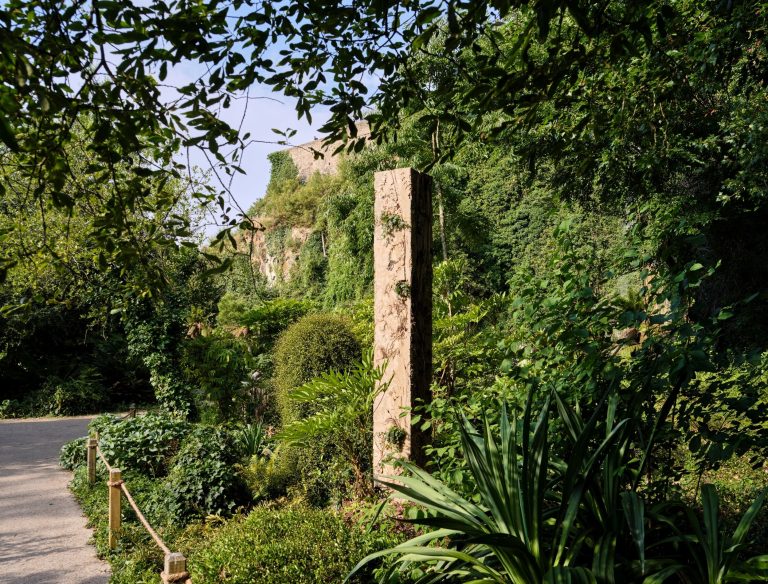
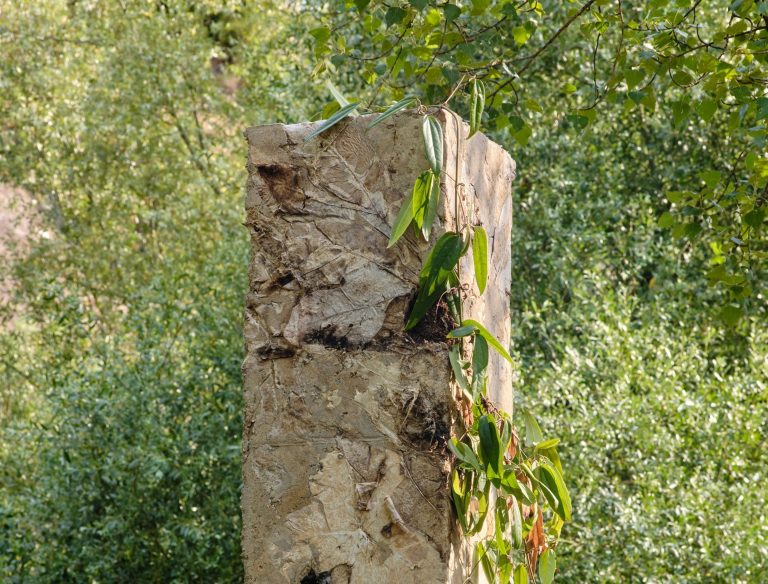
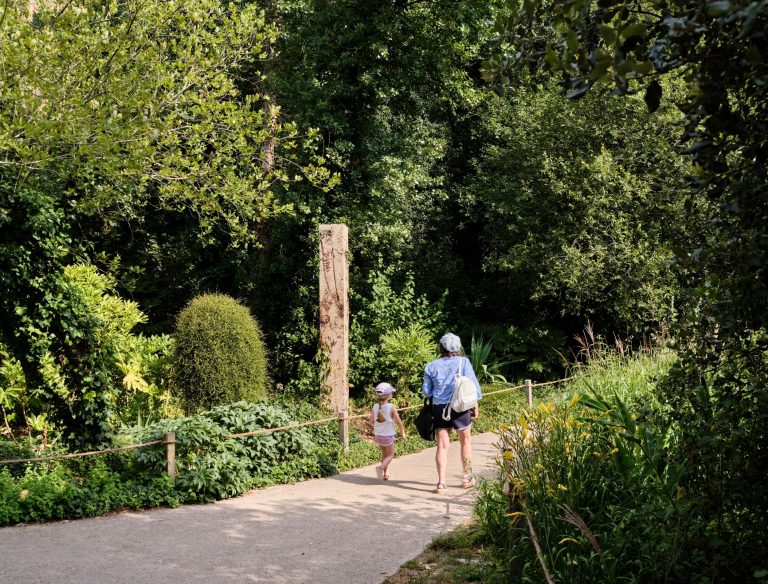
Made from cow dung mixed with earth, cellulose wadding, and cement, Les Mistériennes consists of six monumental columns bearing the imprint of leaves from some of the site’s most remarkable trees. Each sculpture is named after one of the cows that provided the material: Pupille, Rébéca, Rozi, Ange, Lune, and Mimi.
Within their cracks and cavities, mosses and plants form miniature gardens that blur the line between sculpture and habitat. Like primitive architectures, The Mistériennes evoke both the grandeur of ancient civilizations and an organic fragility, transplanting rural memory into an exotic landscape.
Barbara Schroeder (born in 1965, in Kleve, Germany) lives and works in Teuillac, in the Bordeaux region.
Voir le compte Artist’s Instagram account.
Le Voyage à Nantes would like to thank the city’s Parks Department, and Romaric Perrocheau, Franck Leminoux, Catherine Herbette in particular.
Places to visit nearby
Antipodos
Apesanteur
Artistic Shop Signs
BLKNTRNTL
Cavernes, volcans et sables mouvants
Éloge du déplacement
Épilogue sylvestre (Terminus forêt – Retour aux forêts).
Glaner les germes
Le train fantôme
Le va-et-vient des pierres électriques
Les Jardins Mobiles
Les Nids
Private tour guide
Recyclage
Terre en chantier
Terres, le Muscadet du Voyage
Trouver les égards 2024
Voci della strada
Café de la Branche
Canoe Kayak on the rivers Sèvre and Maine
Discover Nantes’ vineyards
For a luncheon on the grass…
Locapino
Nantes-Brest Canal
Sèvre Nantaise river
Véloc’Ouest
Visit with a Nantes resident
Jardin Extraordinaire
The Jardin Extraordinaire is nestled in a former, abandoned granite quarry dolefully named (in English, anyway) “la carrière Miséry”. From the 16th to the 20th century, it supplied stone for many of Nantes’ construction projects. Extraction activities ceased in 1915, while the Brasseries de la Meuse brewery operated on part of the site from 1900 to 1985. After the brewery closed, the site was gradually dismantled and left as wasteland.
In 2005, the City of Nantes acquired the 3.5-hectare (8.7-acre) plot. Its transformation began in 2019, with the public opening of the garden’s western section, and finally extending to the eastern section in 2025.
With its prominent waterfall and lush vegetation, which features over 200 plant species, the garden seeks to recreate the magical universe of Jules Verne’s Extraordinary Voyages — and his descriptions in The Mysterious Island (1874) in particular.

Jardin Extraordinaire, 1 Quai Marquis d'Aiguillon, 44100 Nantes
How to get there?
Public transport: Carrière Misery, Lusançay, Bougainville, Lechat, Hérelle
Self-service bicycles: Garennes, Carrière misery

Closed today.


