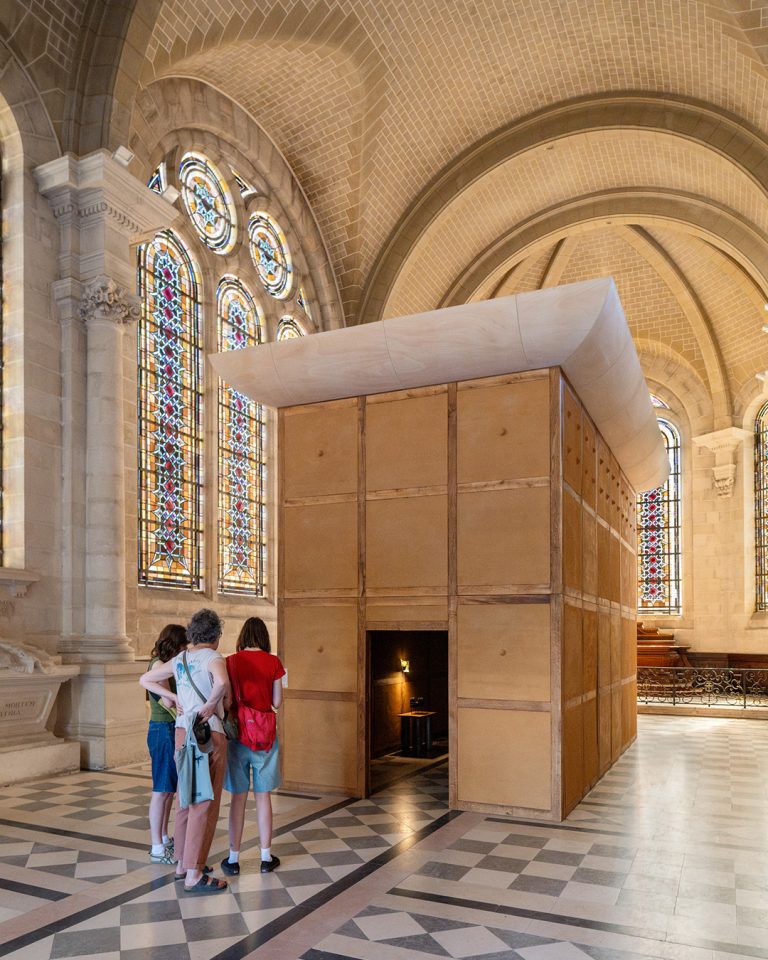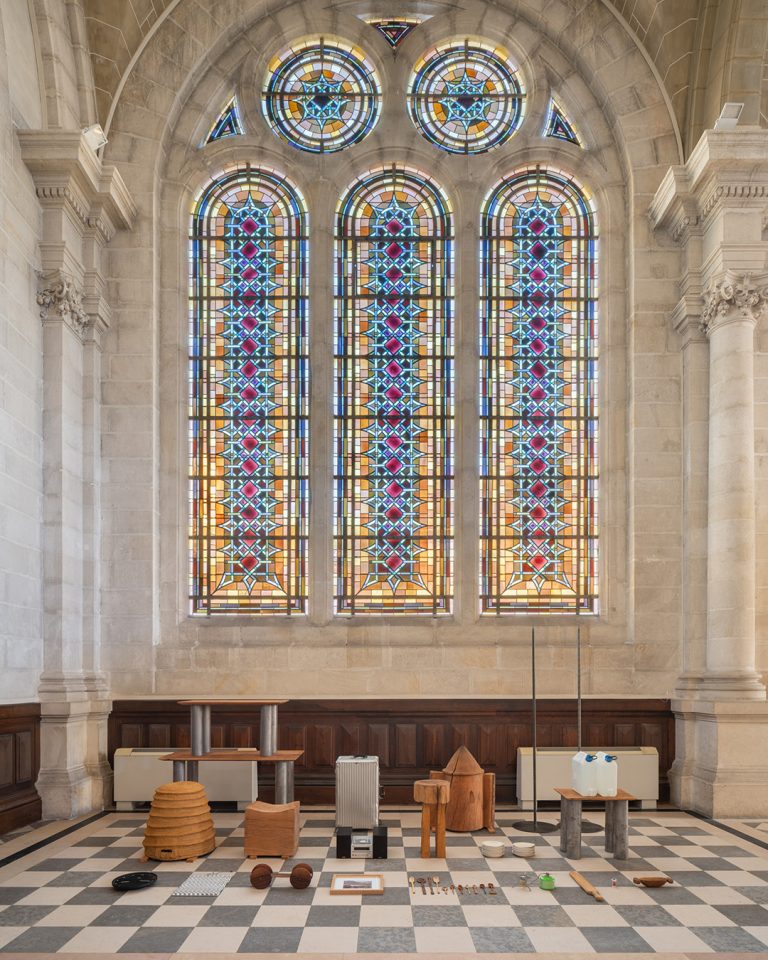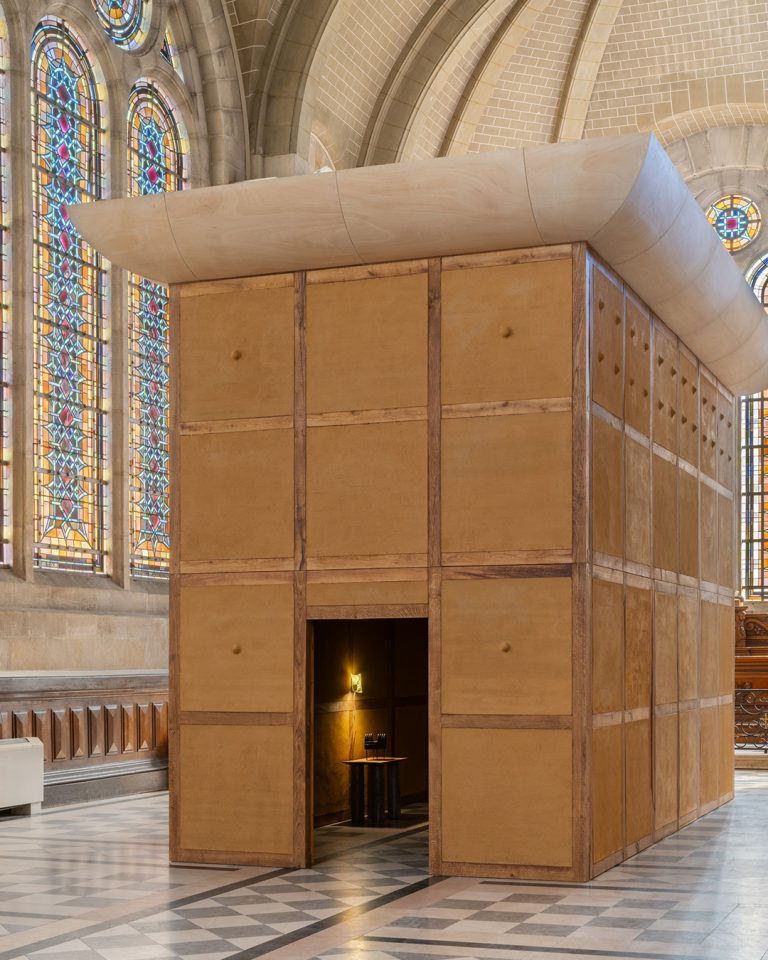
For this exhibition in the Lycée Clemenceau chapel, Sarin offers a new reflection on these structures, which embody both universal notions of habitat and the intimacy of the relationship with matter.
Opened to the public for the first time thanks to the summer edition of LVAN, the Lycée Clemenceau secondary school chapel opens to the public as part of the summer program, which has been transformed into a space that explores Edgar Sarin’s creative vision.
The artist’s work is rooted in the living, organic nature of exhibitions, conceived as worlds unto themselves. He favours natural materials and traditional craftsmanship, focusing on dwellings and vernacular structures.
Inspired by Jean Prouvé’s modular architecture, he has created a structure of oak modules filled with cob made from local soil.
Wooden bowls and spoons, bronze hand warmers, glass lights, and steel seating designed by the artist appear sheltered within this environment. Sarin also includes traditional basket beehives coated with cob and activated through collaboration with beekeepers.
Edgar Sarin was born in 1989. He lives and works in Paris, and is represented by Galerie Michel Rein (Paris, Brussels).
Visit the artist’s website.
Thanks to the Terreux Armoricains collective and the Lycée Clemenceau team for their support.
Le Lycée Clemenceau
The Lycée de Nantes secondary school opened in 1808, in the building of a former Ursuline convent and Nantes seminary. The construction of the chapel in 1892 accompanied a major renovation and expansion project. During WWI, the school became a military hospital and was officially dubbed Lycée Clemenceau in 1919.
The chapel is a simple, single-nave building, and minimalist in design. During WWII, it was occupied by the Germans as a munitions dump and suffered significant damage during the 1943 bombings. It was gradually restored and fitted with new stained glass windows in 1951. The chapel was officially deconsecrated in 1968 and has since been used as a classroom and examination hall.